

The ankle joint bears the most weight in the human body, with approximately 80% of ankle arthritis cases related to trauma, while only about 10% are primary (age-related). Once the cartilage wears down and bones rub against each other, the following symptoms may occur:
- Mechanical Pain: Worsens with activity
- Joint Stiffness and Swelling
- Limited Range of Motion
- Inversion Deformity: The ankle tilts inward
- Walking Difficulties: May require the use of a cane
Many individuals experience ankle sprains (commonly referred to as "twists") in their youth, mistakenly believing that rest for a few days will suffice for healing. However, if not properly managed, repeated sprains or incomplete recovery may lead to health issues that develop into post-traumatic ankle arthritis, severely affecting walking ability and quality of life.
Diagnosis and Staging
The diagnosis of ankle arthritis is primarily conducted through:
- Weight-bearing X-rays
- Computed Tomography (CT) scans
- Magnetic Resonance Imaging (MRI)
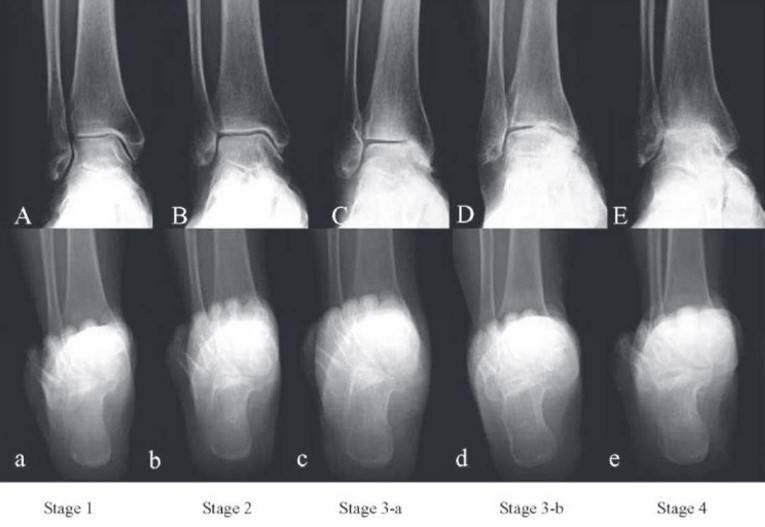
- The severity is evaluated using the Takakura staging system, which divides the condition into four stages, assisting healthcare providers in developing the most suitable treatment plan.
Treatment Options for Ankle Arthritis
Non-Surgical Treatments (Applicable in Early Stages)
- Activity Adjustment: Weight reduction and low-impact exercises such as swimming
- Bracing and Ankle Supports
- Orthotic Footwear
- Medication: Pain relievers and anti-inflammatory drugs
- Injection Therapies: Hyaluronic acid and high-concentration platelet-rich plasma (PRP)
Surgical Treatments (Surgical options may be considered when non-surgical treatments are ineffective.)
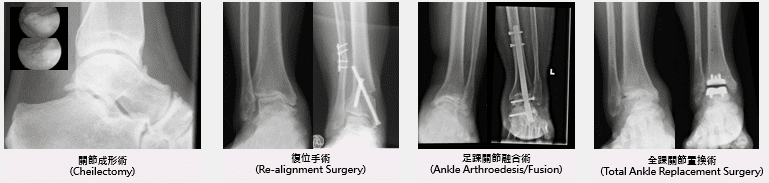
Treatment Options for Ankle Arthritis by Stage
1. Early Ankle Arthritis
- Minimally Invasive Ankle Debridement: This procedure involves smoothing out bone spurs. If joint instability is present, correction can occur simultaneously to stabilize the ankle joint.
2. Mid-Stage Ankle Arthritis
- Re-alignment Surgery: If joint deformities occur, surgery may be necessary to correct the bone angles and restore normal alignment of the ankle joint.
3. Late-Stage Ankle Arthritis
When degenerative ankle arthritis reaches an advanced stage, surgical intervention becomes essential, with the most common options being:
- Traditional Ankle Fusion Surgery: Damaged cartilage is removed, and the tibia is fused to the talus using metal screws. While this effectively eliminates pain, it sacrifices joint mobility—post-surgery, the range of motion may be only a quarter of that of a healthy person, resulting in a less natural walking pattern. There’s also a risk of accelerating degeneration in nearby joints. Weight-bearing on the foot is restricted for 1-2 months post-surgery. This option is typically suitable for younger, overweight patients or those involved in physical labor.
- Total Ankle Replacement Surgery: Similar to knee replacement, this procedure removes the damaged joint surfaces and replaces them with artificial joints. It preserves ankle joint mobility while effectively relieving pain. Total ankle replacement techniques have rapidly advanced over the past two decades, now in their fourth generation. These advancements offer several benefits: improved bone integration, reduced bone removal requirements, the use of highly cross-linked polyethylene to minimize dissolution issues, and designs that better match anatomical structures, thus enhancing quality of life.
Studies have shown that total ankle replacement excels in pain relief, functional recovery, and patient satisfaction, with an overall complication rate lower than that of fusion surgery, making it an increasingly preferred treatment for late-stage ankle arthritis.
| Traditional Ankle Fusion | Total Ankle Replacement | |
| Stability | Ideal | Ideal |
| Flexibility | Limited movement |
|
| Pain Relief | Ideal | Ideal |
| Recovery Time | Approximately 6 months; no weight-bearing for 1-2 months post-surgery | Approximately 6 months; earlier weight-bearing is possible |
| Major Complications | Nearby joints may develop inflammation within 20 years | Risk of implant loosening/bone dissolution |
| Surgery Duration | About 90 minutes | About 90 minutes |
| Post-Operative Quality of Life | High | Higher |
| Suitable Candidates |
|
|
Early Treatment to Prevent Future Issues
If you or a family member is experiencing ankle joint problems, it is advisable to consult an orthopedic specialist for a comprehensive evaluation. Early diagnosis and appropriate treatment are effective in preventing the worsening of issues, allowing you to regain a normal lifestyle.

.png)